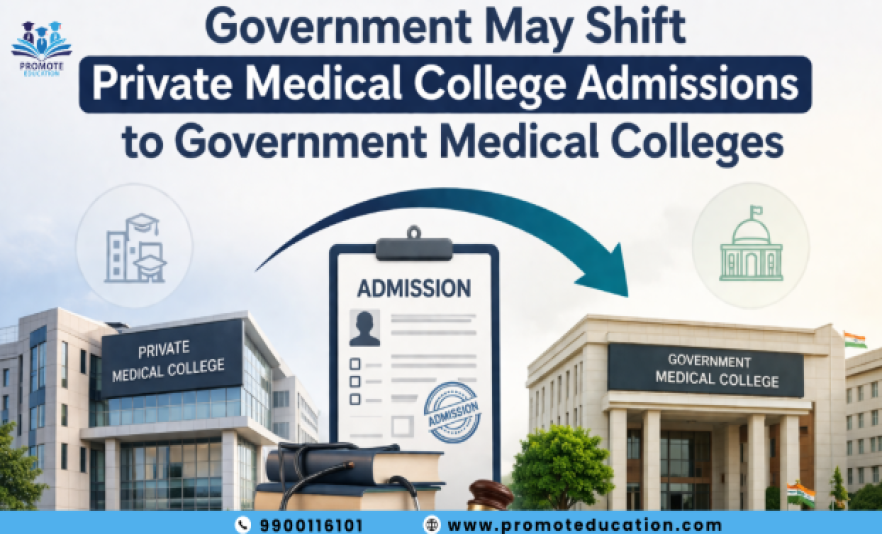
Government May Shift Private Medical College Admissions to Government Medical Colleges
Insights On Admission For Private Medical Colleges

Insights On Admission For Private Medical Colleges
There is a major transformation going on in the private medical college admission process in India that reanalyzes how the aspirants are securing MBBS seats. Complaints regarding the unfair practices have been a concern since forever and so the government control on private medical college admissions is strong. They are framing strict rules now onwards for a smooth and fair private medical college admission process in India.

We all have seen the struggle of students and parents behind the entire admission procedure with a lack of transparency and last-minute seat cancellations. Reports have been circulating lately regarding the planning behind the process of centralized admission through government institutions. This will certainly ensure fair and merit-based admission. In India, every year over 1.2 lakh MBBS seats are available through NEET, although these sudden changes can certainly change the entire dynamics of thousands of students.
In recent times, the private medical college admission rules 2026 include NEET-based counselling. It is managed by MCC and state authorities. Although, it is mandatory for the aspirants to qualify NEET UG (the only entrance examination conducted in India for MBBS admissions in private colleges India 2026).
Even after the centralized counseling process for private medical college admission process in India , the last stage includes direct reporting to the private institutions. Here the students and the families face the pressure for full deposit of the fees, limited decision time and lack of grievance redressal. The government quote includes around 50%. The rest belongs to the management quota/NRI quota.
After multiple complaints of malpractice and harassment, the government's control on private medical college admissions has turned into a serious concern. As per the reports, the students were often asked for more fees along with the risk of losing their seats.
To fix this issue and eliminate the unfair practices, the authorities are aiming to standardise the admission process and block exploitation.
The entire point of making these changes is to restore the trust parents show. They have been investing ₹50 lakh to ₹1.5 crore for MBBS education and the bare minimum in return we can do for them is show some clarity and keep the transparency. The ultimate goal is to make merit the primary and only criteria and make the trust stronger for the parents in the system.
The centralised medical admission process in India only aims to bring all sorts of private admissions under the government's supervision. The rules are kind of surpassing like instead of private campus reporting, they now have to finish the formalities at designated government medical colleges.

A centralised document verification, counselling assistance and fee payment are also expected in the newly introduced reforms for a less confusing and streamlined admission process.
Annually, around 1.29 lakh MBBS seats are available and therefore with a unified system, the problems can be significantly reduced and can be turned into the biggest reforms in the history of Indian medical education.
The current counselling has been divided into two halves and they are: All India Quota (15%) And State Quota (85%).
Under this newly acknowledged private medical college admission process India, even if the counselling is centralised but the execution will shift to the government centres. With this there will be exceptional monitoring, and students don’t have to solely depend on the private institutions for confirmation. This creates a safe environment during the reporting phases.
This completely focuses on transparency, regulation and accountability and it might mandate the payment and document verification under the government supervision for the government control on private medical college admissions.

The National Medical Commission (NMC) has also started taking steps to protect the students. The colleges are getting restricted from charging college fees beyond the study of 4.5 years. Parents can now rely on the system for better conduct of fair practices.
Despite all the rules and reforms, getting into the private medical college admission process in India is still overwhelming. Well, this is where Promote Education can be of great help. They play a crucial role with the expert counselling, real time insights and updates, and customised guidance. This will help the aspirants to make informed decisions.
They will suggest to you the right set of colleges that go with your budget and other interests and you can easily avoid the costly mistakes. Ensure a smooth journey with the right guidance and free counselling.
It means admissions to private colleges may be centralized under NEET counselling for transparency and merit-based allocation.
It can make admissions fairer and more transparent, but may also affect fees and seat allocation policies.