Medical college paths grind relentlessly, stealing sleep and social lives alike. Bigger hurdles loom now—not just Physics woes, but syllabus confusion too. New NCERT books clash with old PDFs on your desk, breeding risky gaps that trap unwary students. Skip a topic presumed gone, and one sneaky question can snatch 4 marks fast in this brutal 720 mark race. Telegram frog rumors and chapter whispers fuel endless chaos—you crave facts, not fog, to stay ahead. We studied the official notices closely, sifting noise from truth, and built your clear survival kit today. Trust this: align your prep sharp, bridge those gaps, and turn uncertainty into your edge.
What Is the NEET (UG) 2026 Syllabus Update?
The National Medical Commission decides this, and the official syllabus for NEET (UG) 2026 is already available. The good news is simple: there are no major shock changes in the current official syllabus. The structure remains broadly stable and continues to align closely with the rationalized NCERT pattern used in recent years. This means many deleted or reduced areas remain outside the main focus, though a few listed topics still need careful attention. The syllabus is more streamlined now and focuses more clearly on core concepts. That reduces confusion to some extent, but not fully. Some topics still feel “hidden” to students because they are easy to miss in preparation, even when they appear in the official syllabus. Topics related to Experimental Physics, certain practical-style Chemistry areas, and specific Biology inclusions fall into this category. Ignoring these can be dangerous for your score. The safest move is to read the official syllabus line by line and prepare accordingly.
 2026 Syllabus Update.png)
Why Does This Update Matter?
The syllabus is your bible for the next few months. If you study outside it, you lose time, and if you miss a line inside it, you lose marks. This update matters for focus first. You can stop spending too much time on chapters that no longer form part of the current core syllabus. You save many hours by doing this wisely. This update matters for resource selection too. Old modules may still contain outdated portions, and old question banks may still mix removed or reduced topics with relevant ones. You need to filter your materials carefully. This update matters for rank as well. In such a tight exam, even one question matters. Knowing which topics are clearly present in the official syllabus gives you an edge. Knowing which rumors are false gives you an edge, too. This specific clarity matters because it can separate a well-prepared aspirant from an underprepared one.
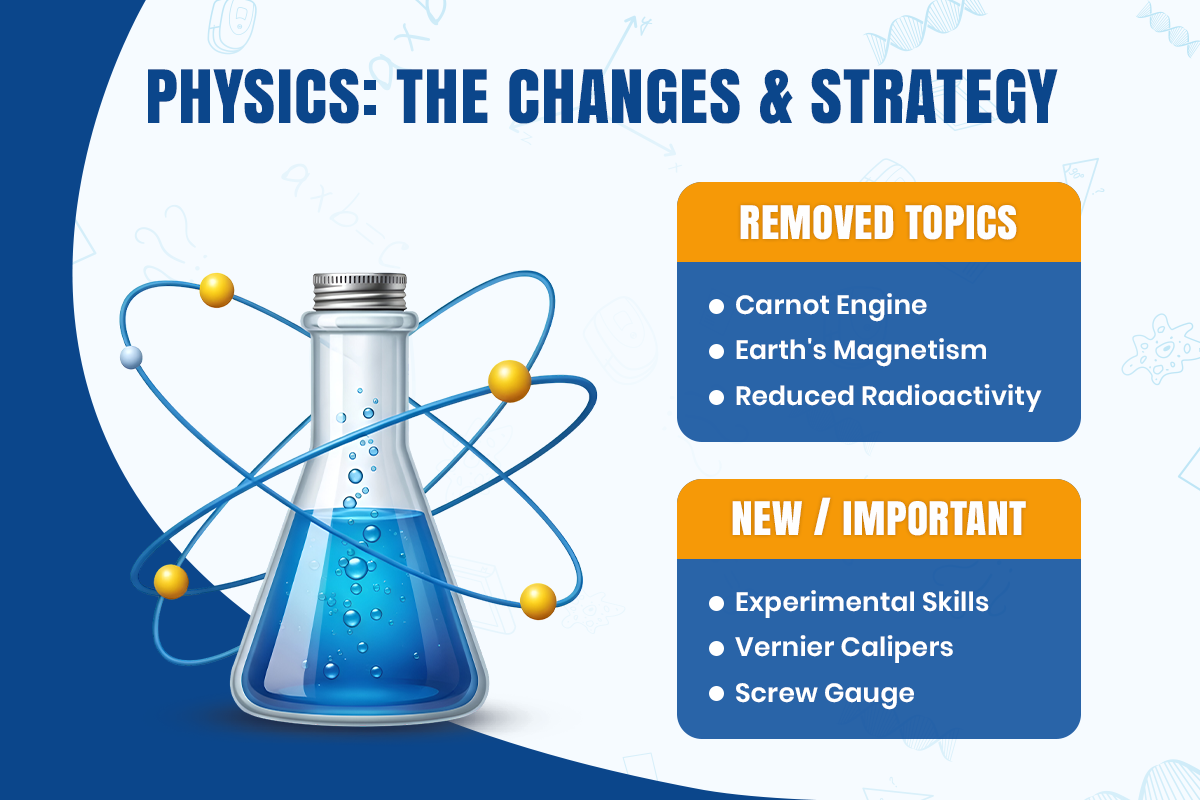
Physics: The Changes & Strategy
Physics is the rank decider in this competitive exam. The syllabus is cleaner now than many students assume.
What is Reduced or Not a Major Focus?
- Rolling Motion appears reduced in practical exam focus compared with what many older materials suggest.
- Carnot Engine is not part of the present core Thermodynamics focus in the official syllabus.
- Some Radioactivity details seen in older prep material do not appear with the same emphasis now.
- Earth’s Magnetism is not a major standalone focus in the present syllabus wording.
What is Critical?
- Experimental Skills are highly important for students.
- It includes Vernier Calipers and Screw Gauge.
- It includes the simple pendulum and error-based understanding.
- Strategy: Do not skip the lab-based and measurement-based portions.
- Read the experiments section thoroughly.
- Questions from such areas can be direct and scoring.
Smart Plan (Physics)
- Daily: Dedicate 1 hour to formula revision.
- Focus: Prioritize Mechanics and Electrodynamics strongly.
- These areas usually form a major share of the paper.
- Practice: Solve PYQs regularly.
- But skip questions from clearly outdated or irrelevant topics to save time.
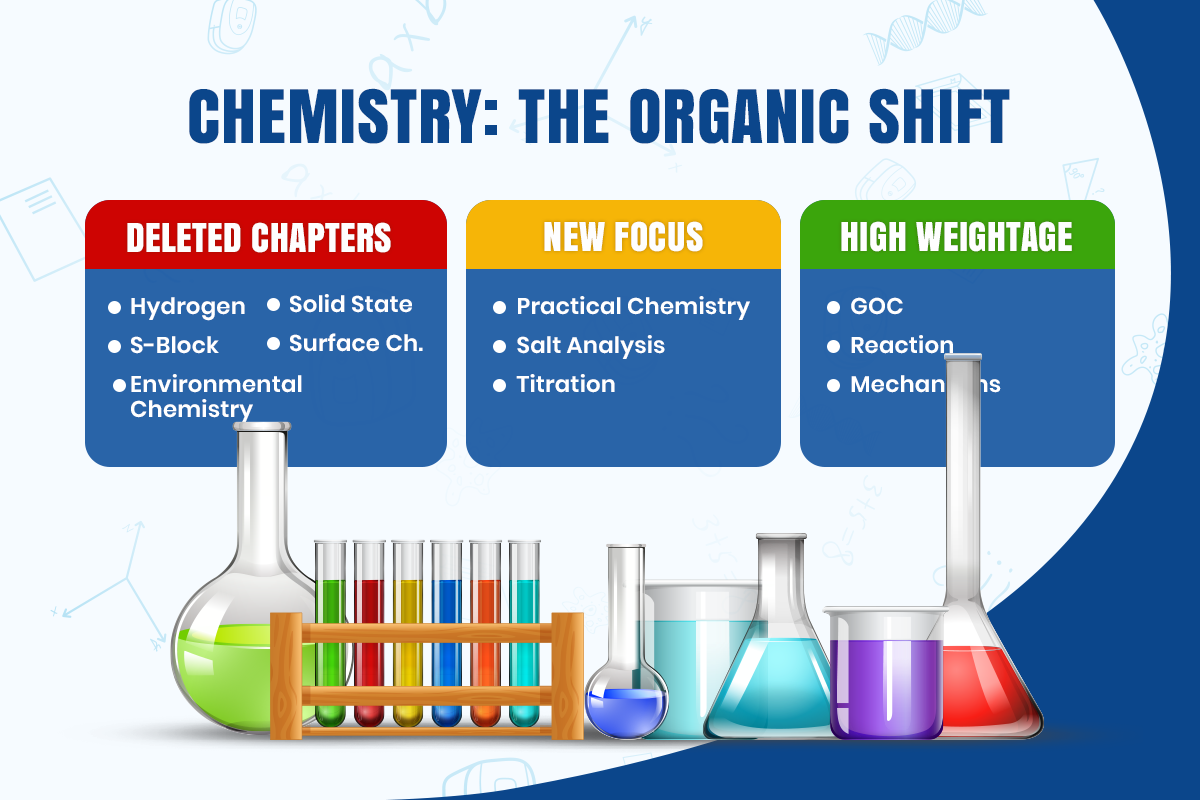
Chemistry: The Organic Shift
Chemistry feels different now for many aspirants because several traditionally memorized portions have reduced relevance in current preparation. Inorganic Chemistry appears lighter than before in many areas, while conceptual and application-based sections remain important.
What is Removed or Reduced in the Current Preparation Focus?
- The Hydrogen chapter is no longer a main standalone focus.
- S-Block Elements are not part of the present central syllabus list.
- Environmental Chemistry is removed.
- Solid State is not part of the present syllabus.
- Surface Chemistry is removed.
- Metallurgy is removed.
- Polymers are removed.
- Chemistry in Everyday Life is removed.
What is Critical?
Practical Chemistry now deserves serious attention.
- It includes Salt Analysis concepts.
- It includes Titration principles.
- It includes tests related to Organic compounds.
- Strategy: treat practical-style Chemistry seriously and revise it with the same discipline as theory.
Organic Chemistry also becomes more important in relative preparation terms.
Since some memorization-heavy sections are reduced, conceptual Organic preparation matters more now.
- Master GOC completely.
- Master Reaction Mechanisms thoroughly.
Smart Plan (Chemistry)
- Physical: This is formula-based, so practice numericals.
- Organic: Write reactions daily and make charts.
- Inorganic: Focus on the Periodic Table and Chemical Bonding.
- These remain foundational.
- Plus, Coordination Compounds stay essential.
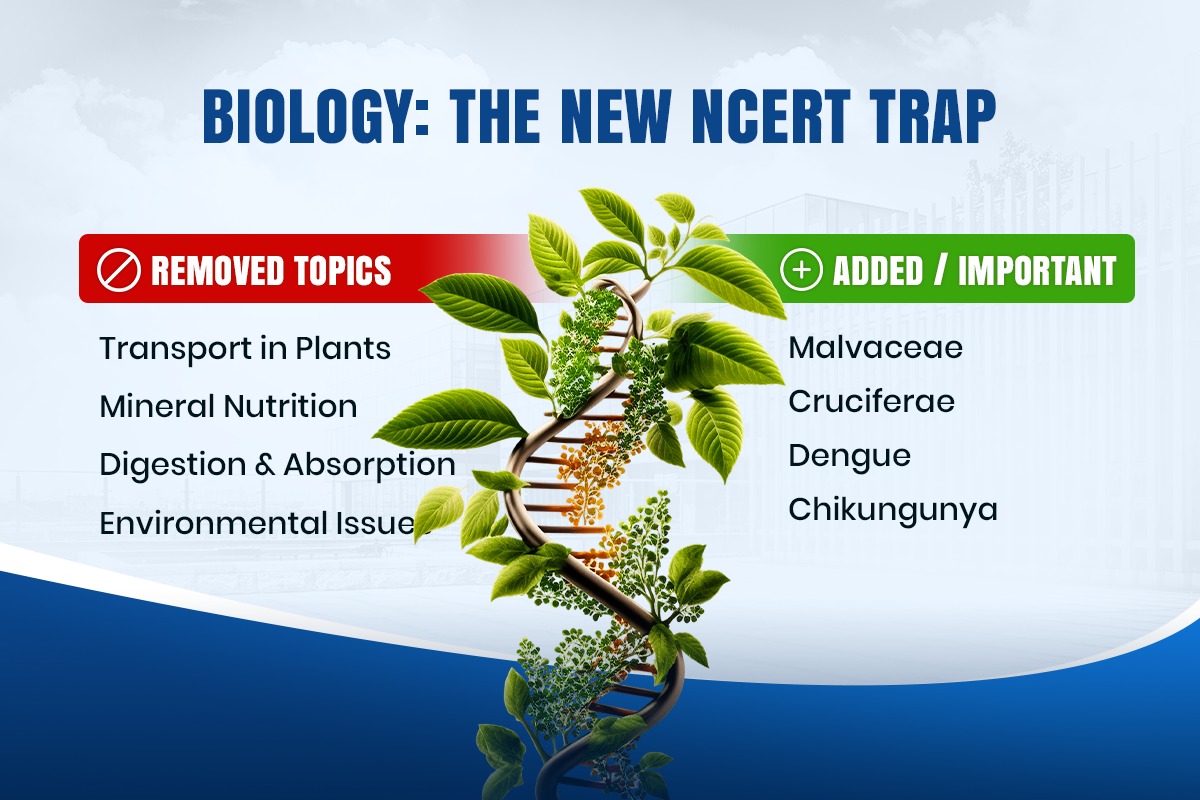
Biology: The New NCERT Trap
Biology is the scoring subject for every aspirant. A near-perfect score remains the target you must aim for.
What is Removed or Reduced?
- Transport in Plants is not part of the current main syllabus.
- Mineral Nutrition is removed.
- Digestion and Absorption are removed.
- Reproduction in Organisms is removed.
- Strategies for Enhancement in Food Production have been removed.
- Environmental Issues has been removed.
What is Added or Easily Missed?
- New Families like Malvaceae and Cruciferae need careful attention.
- Check the official syllabus wording for exact coverage.
- Topics related to animal morphology or anatomy are still discussed in ways that confuse many students.
- Dengue and Chikungunya appear in the Human Health area.
- Strategy: Stick to the new NCERT books strictly for your main preparation.
- But also cross-check the official syllabus for the listed topics that students often overlook.
- Do not trust old coaching notes blindly.
Smart Plan (Biology)
- Read the NCERT line by line repeatedly.
- Practice diagrams and labeling accurately.
- Memorize names, classifications, and factual lines carefully.
- Revise Biology every single day.
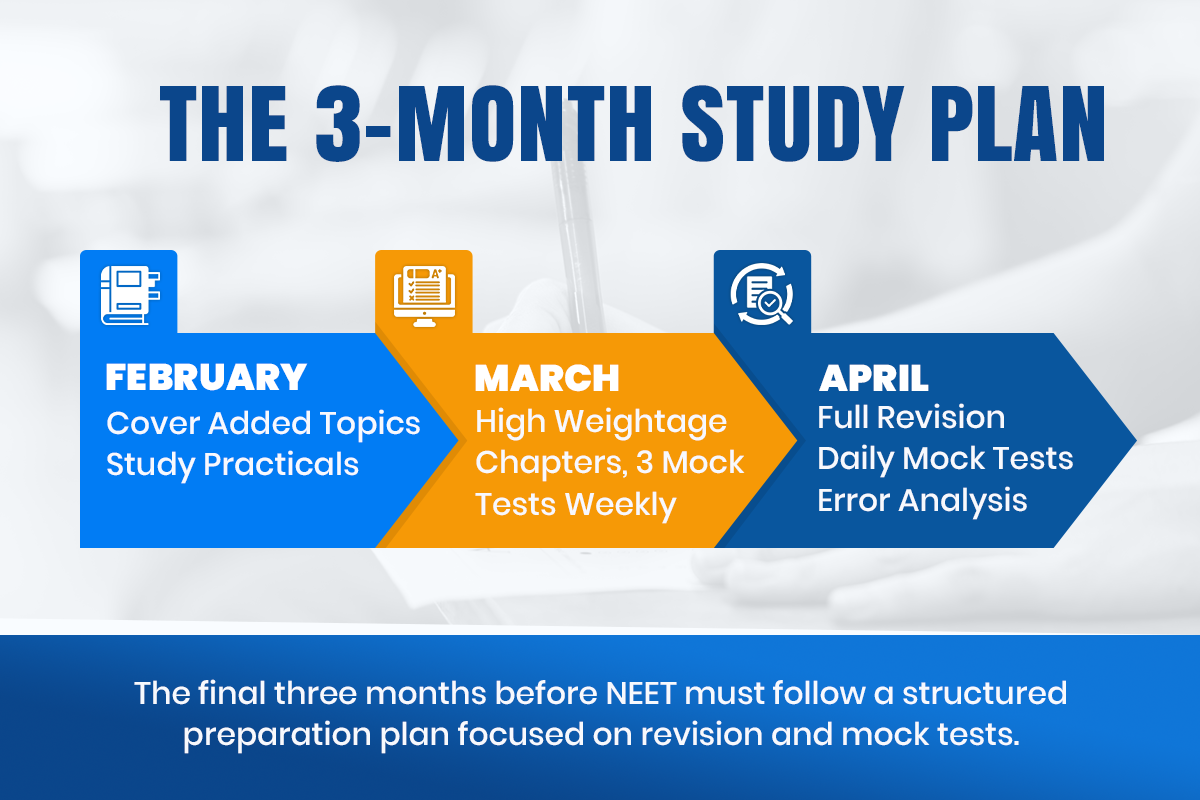
Practical Use Cases: The 3-Month Plan
You are now in the final stretch before the exam. Here is a practical breakdown for the sprint ahead.
Month 1: The Weak Links
- Finish the easily missed listed topics first to clear the backlog.
- Study Experimental Physics in detail.
- Study Practical Chemistry thoroughly.
- Study the new Plant Families carefully.
- Why? Because many students ignored them earlier.
- Secure these marks now.
Month 2: The High Weightage
- Physics: Focus on Optics, Modern Physics, and Current Electricity.
- Chemistry: Focus on Equilibrium, GOC, and Bonding.
- Biology: Focus on Genetics, Ecology, and Human Physiology.
Take 3 mock tests per week with discipline.
Month 3: The Rapid Fire
- Stop reading too much new material.
- Make revision your main priority.
- Take mock tests in the exam time slot whenever possible.
- Analyze errors instantly after the test.
- Sleep well to keep your mind sharp.
Limitations of the Syllabus
The syllabus is a guideline, but students must still stay careful.
- Ambiguity:
- Some topics overlap in wording.
- Phrases like “basics of” can still create confusion.
- Old NCERT vs New NCERT:
- Old materials may contain concepts that are no longer central to the current syllabus.
- That does not mean every old concept should consume your time now.
- Safe Bet:
- Read the summaries of borderline or previously studied deleted areas once if needed for mental clarity.
- Do not go deep into them.
- Your main loyalty must remain with the official current syllabus.
Future Outlook: The Cutoff Surge
A slimmer syllabus can make preparation look more manageable, but competition remains fierce. That means accuracy matters even more. Negative marks hurt harder in tight races, so silly mistakes must be hunted down early. Whether cutoffs rise or shift, disciplined preparation and precision will matter more than panic.
Conclusion
NEET (UG) 2026 moves forward with a cleaner path, but the race remains ruthless. Your map must be correct, and your steps must stay sharp. Download the official syllabus PDF, remove irrelevant portions from your prep, and build your notes around what truly matters. Daily revision and disciplined mock practice can still move the dream closer. Use time well. Stay calm. Stay exact. Keep running toward that white coat.
Vulnerabilities: Spot the Traps (NEET Syllabus 2026 Risks)
Syllabus whispers breed doubt fast. Claims shine bright, but cracks hide deep. NEET 2026 changes feel fresh—yet many student discussions mix current facts with older changes and recycled coaching claims. Physics removals, Biology confusions, and weightage assumptions often circulate without context. Weightages like “60%” are estimates, not official promises. Cutoff numbers also shift each year and should never be treated as a fixed truth. The deleted syllabus lists floating online may be partly helpful, but they are not equal to official authority. Practical sections demand focus, and ignoring them can cost easy marks. Telegram noise often travels faster than facts. Cross-check the official syllabus PDF now. Flaws slip in unnoticed. Spot them early, or regret bites hard. Turn risks into your shield—verify every line.
Stay Safe: The Hard Truth
Numbers here are approximate only. Dates may shift. Percentages can change. Cutoffs may rise or fall unpredictably. NEET syllabus interpretation can also vary across blogs and coaching platforms, so always verify through official NMC, NTA, and official websites first. No guarantees are made here. No promises are made or implied. This content is a general guidance-based blog and should not be treated as a substitute for official notices. Official PDFs and notices hold final authority. Cross-check always. Act with caution. Stay informed. Secure your path wisely.
References:

NMC Official Website
NTA NEET Portal
NCERT Official PDFs
Allen Syllabus Analysis
Careers360 Deleted Topics List